Archer Wu logo Archer Wu

A story written in rocks and fossils

Earth Through Deep Time

4.57 billion years of change, from the first minerals to us

We cannot watch the ancient Earth directly. Its history has to be pieced together from minerals, rocks, fossils and chemistry. This journey follows that evidence, while making clear where the story is certain and where scientists are still debating.

See deep time at a glance
Dates follow the international geological chart Every image is clearly identified Uncertainty is shown openly Sources are listed below
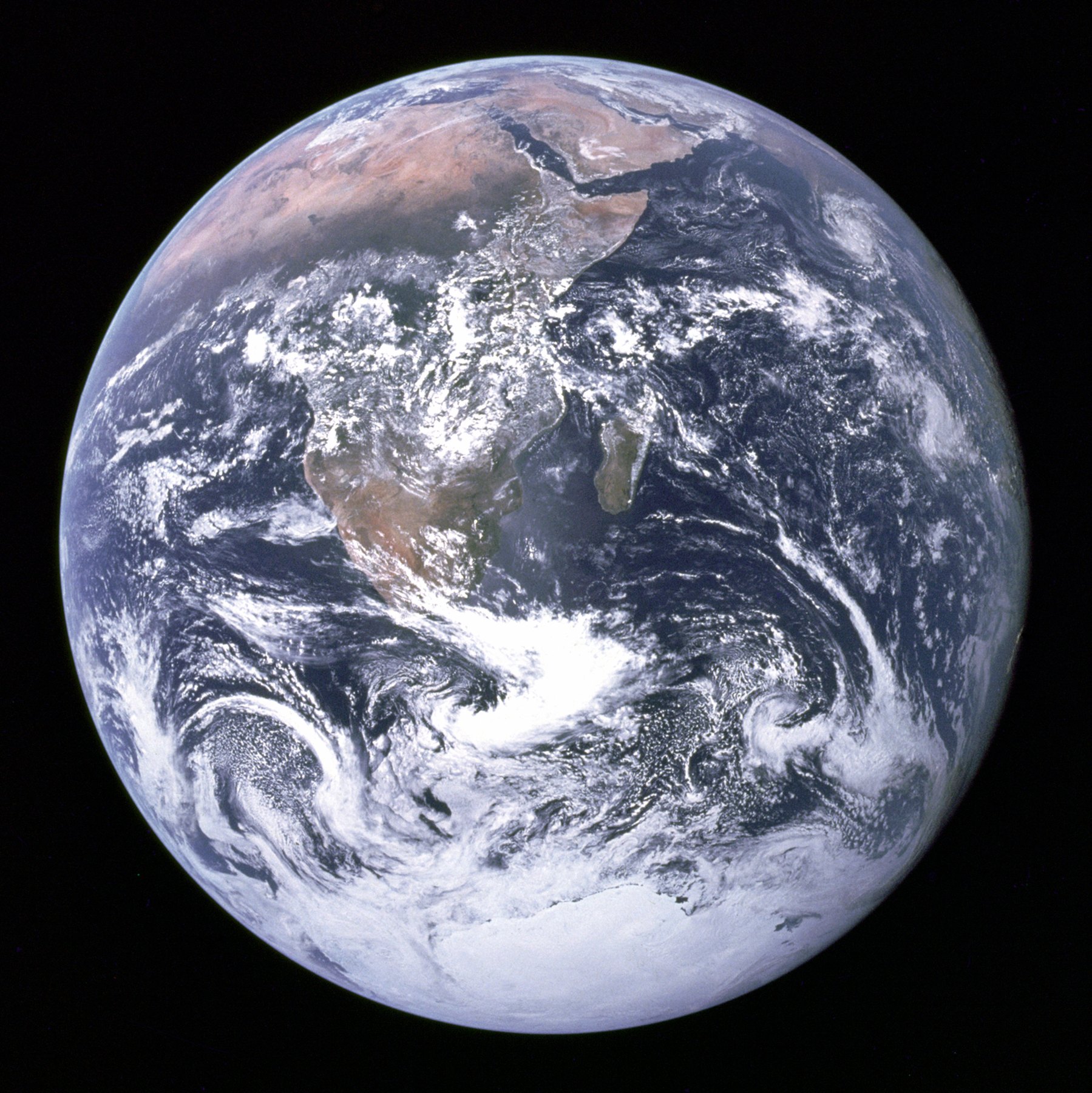
The Earth photographed by the Apollo 17 crew in 1972
Earth as photographed by the Apollo 17 crew in 1972—a view of our planet today. NASA, public domain.
Chapter 1

Hadean

4567–4031 Ma

Earth was taking shape. Metal sank to form the core, rock separated into mantle and crust, and the first minerals began to preserve traces of this violent young world. Almost no intact Hadean rock remains, so the story comes from tiny mineral grains, meteorites, lunar samples and physical models.

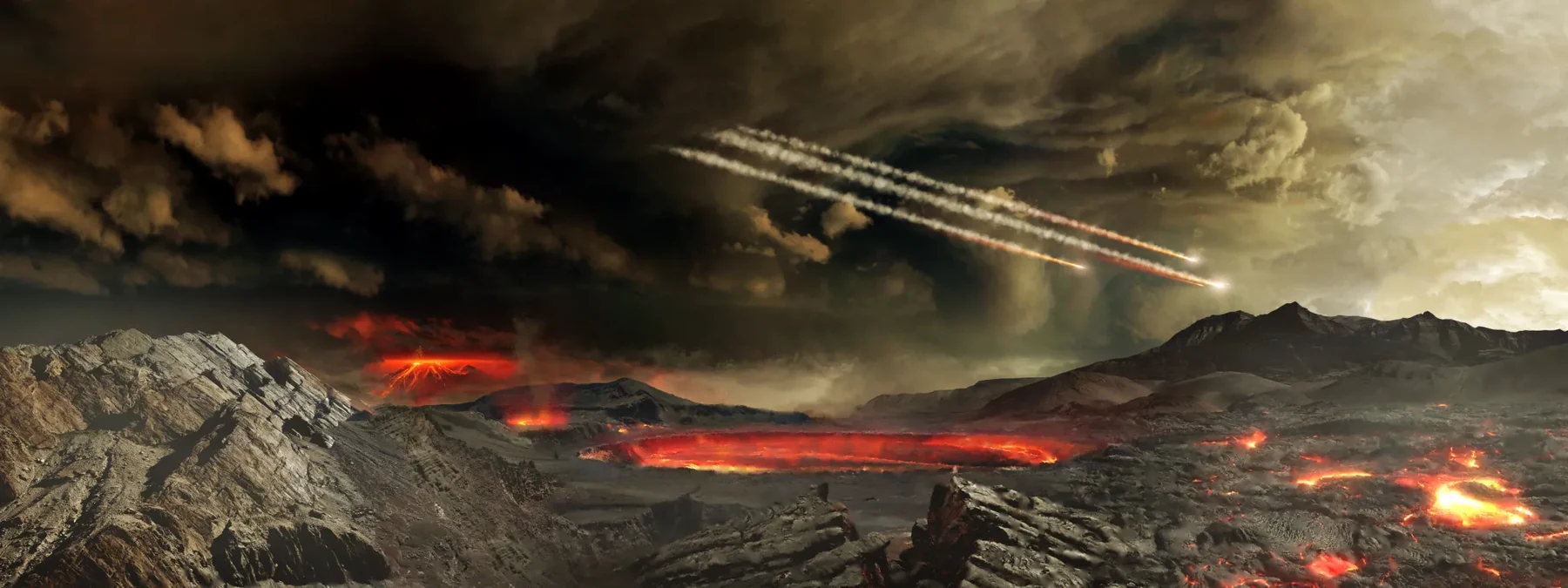
NASA artist's reconstruction of a possible Hadean landscape with molten rock and incoming impactors
One possible view of the young Earth

NASA’s illustration imagines a hot, impact-scarred surface with active volcanism and newly forming crust. It is not a map or a snapshot of the whole Hadean. The intensity and timing of the proposed late bombardment are still debated.

NASA Goddard Space Flight Center Conceptual Image Lab, artist's reconstruction.

What we know

  • Earth formed about 4.54 billion years ago from material orbiting the young Sun. The geological timescale begins at 4567 Ma, close to the age of the oldest dated inclusions in meteorites.
  • The leading explanation for the Moon is a giant impact early in Earth’s history. The broad picture is well supported, but the timing and details are still being refined.
  • The oldest known zircon grains from Earth are about 4.4 billion years old. Their isotopes point to early crustal recycling and may record contact with liquid water, although the interpretation is not settled.
Moments that changed the planet

The Solar System takes shape

The oldest dated inclusions in meteorites provide the conventional starting point for Solar System history.

Earth comes together

Repeated collisions, melting and separation create the core, mantle and early crust.

A giant impact forms the Moon

Lunar rocks and computer models point to a major early collision, although published ages still cover a wide interval.

The oldest dated zircon on Earth

A mineral grain survived for 4.4 billion years, carrying a chemical record of the young planet.

What scientists are still working out

No reliable map can show the exact continents, ocean colour or cloud patterns of the Hadean. Any complete globe from this time is necessarily an artistic reconstruction, not a direct record.

Chapter 2

Archean

4031–2500 Ma

The planet became more stable. Oceans, long-lived crust and microbial ecosystems were established, while the atmosphere still held very little oxygen by modern standards.

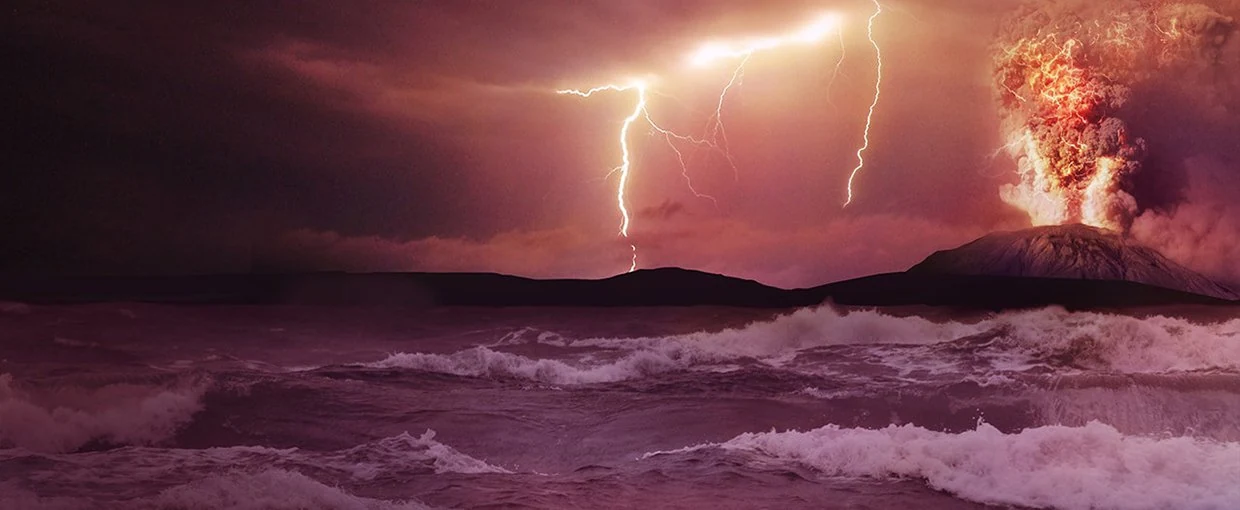
NASA artist's reconstruction of an Archean ocean, volcanic coast and oxygen-poor sky
An Archean coast, reconstructed

This artist’s concept shows a world of oceans, volcanic land and an oxygen-poor atmosphere, before plants or animals lived on land. The shoreline, weather and colours cannot be recovered exactly; they are informed choices rather than observations.

NASA, artist's concept of the early Earth.

What we know

  • Several kinds of evidence indicate that life existed at least 3.5 billion years ago. Older claims are possible, but remain disputed.
  • Archean ecosystems were microbial. Shape alone rarely tells us exactly which organisms were present or how they obtained energy.
  • Stromatolites are layered structures built through the interaction of microbes, sediment and water chemistry. Ancient examples do not, by themselves, prove that cyanobacteria or oxygen-producing photosynthesis were already present.

Moments that changed the planet

The earliest signs of life

Carbon isotopes, microscopic structures and sedimentary patterns are strongest when they point in the same direction; no single clue is enough on its own.

Microbial communities leave clearer traces

Microbial mats and stromatolite-like structures appear in several well-preserved ancient rock sequences.

Oxygen-producing photosynthesis evolves

It appeared before oxygen built up permanently in the atmosphere, but its exact origin remains uncertain.

What scientists are still working out

We do not know what the first organism looked like, where life began or exactly when oxygen-producing photosynthesis evolved. Hydrothermal vents, shallow pools and other settings are plausible ideas, not settled history.

Chapter 3

Proterozoic

2500–538.8 Ma

Oxygen became a lasting part of the atmosphere, complex cells diversified, vast ice ages reshaped the planet, and large soft-bodied organisms appeared near the end of the eon.

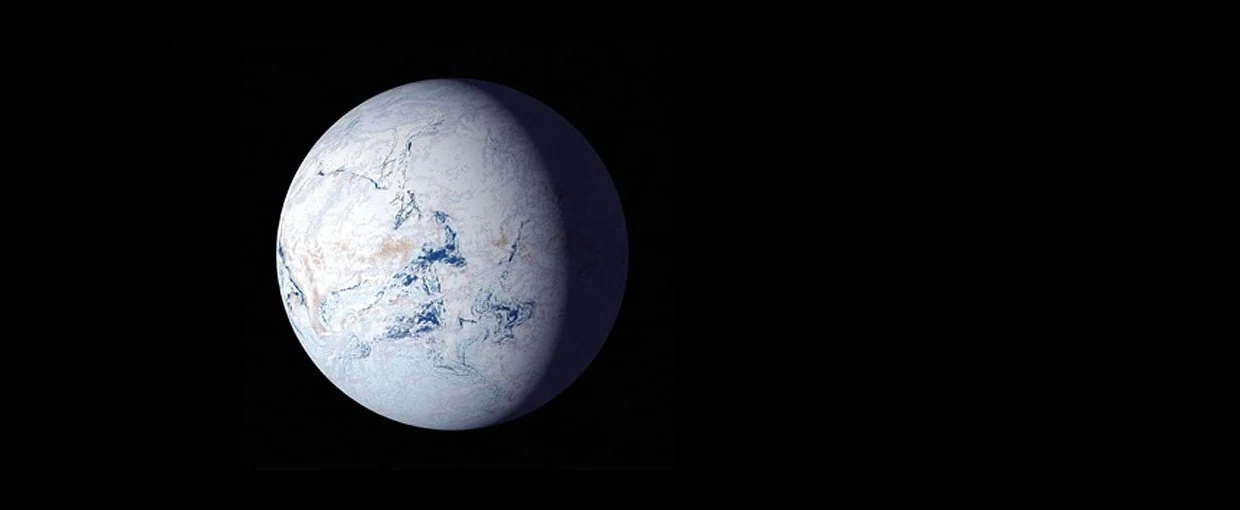
NASA artist's impression of a largely ice-covered Snowball Earth
A planet under ice

This reconstruction shows one end-member version of a Cryogenian ‘Snowball Earth’. Geological evidence supports exceptionally extensive glaciation between about 720 and 635 Ma, but scientists still debate whether the oceans were completely sealed by ice or retained areas of open or thin water.

NASA, artist's impression.

What we know

  • The Great Oxidation Event, roughly 2.4–2.2 billion years ago, marks the first sustained rise of oxygen in the atmosphere. Oxygen did not jump straight to modern levels, and different parts of the ocean changed at different times.
  • Complex eukaryotic cells arose before their clearest fossils appear. Their diversification unfolded over a long period, and molecular-clock estimates depend on the models and fossils used for calibration.
  • Cryogenian ice ages reached extraordinary scales. “Snowball Earth” describes several related models, and scientists still debate how much open water remained.
  • Ediacaran seas supported large, soft-bodied organisms. Some may be related to animals, while others do not fit neatly into living groups.

Moments that changed the planet

Oxygen begins to accumulate

Atmospheric oxygen rises above the extremely low levels of the Archean, although oxygenation remains patchy across the oceans.

Complex cells leave clearer fossils

Fossils and chemical traces show increasingly diverse eukaryotes, even when their exact relationships are hard to identify.

The great Cryogenian ice ages

The Sturtian and Marinoan glaciations transform climate, erosion and ocean chemistry.

Large Ediacaran organisms spread

After about 575 Ma, large soft-bodied forms become prominent in fossil communities before the Cambrian begins.

What scientists are still working out

Oxygen did not rise everywhere at once or in one smooth climb. The rock record supports a series of uneven changes, not a single precise global curve.

Chapter 4

Paleozoic

538.8–251.902 Ma

Animal life diversified in the seas, plants and animals moved onto land, forests changed the atmosphere and carbon cycle, and the era ended with the largest known mass extinction of the Phanerozoic.

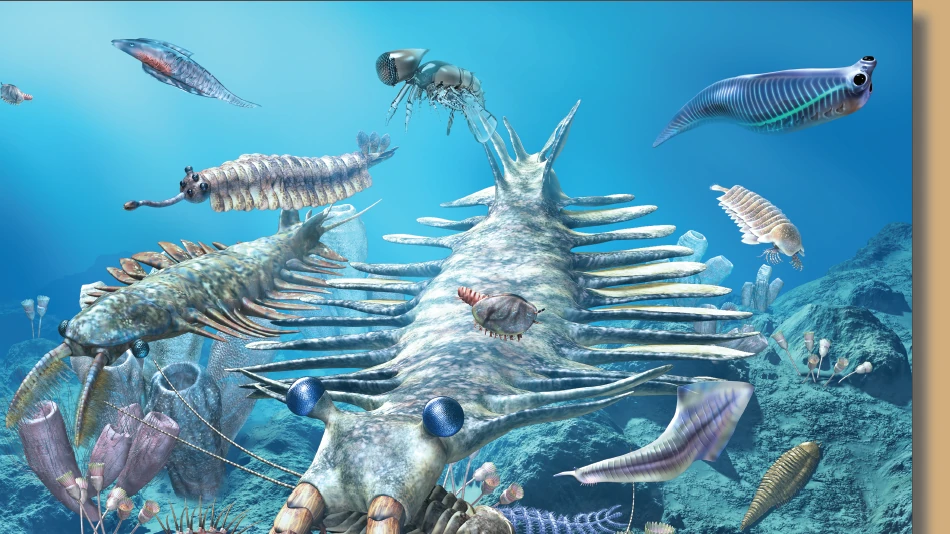
USGS reconstruction of a Cambrian marine communityCambrian sea · about 500 Ma
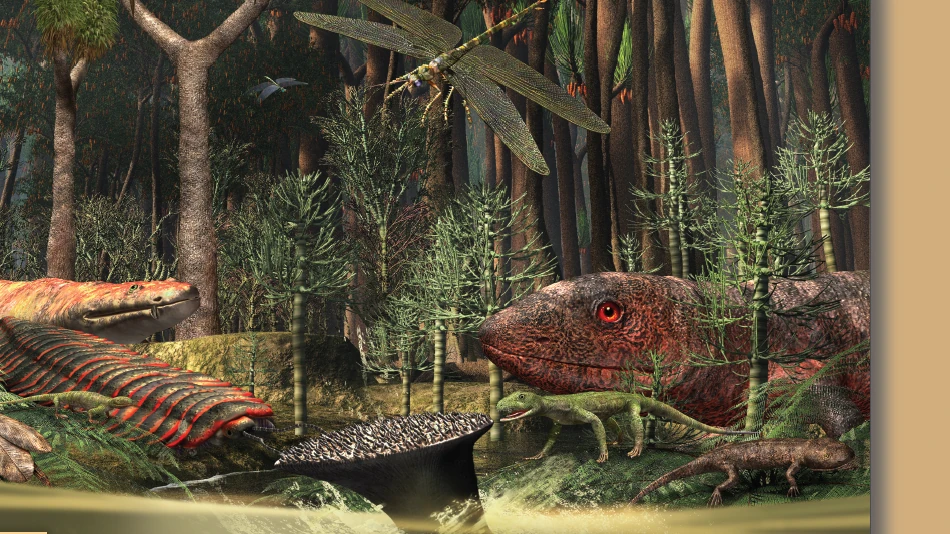
USGS reconstruction of a Carboniferous swamp forestCarboniferous wetland · about 320 Ma
From Cambrian seas to Carboniferous wetlands

The Paleozoic lasted almost 287 million years, so no single scene can stand for it. The left reconstruction presents a Cambrian marine community; the right shows a Carboniferous wetland with giant lycopsids, arthropods and early tetrapods.

U.S. Geological Survey ‘Trek Through Time’ dioramas by Masato Hattori, public domain; cropped to the illustrated scenes.These scenes are scientific reconstructions, not photographs. Each represents a particular interval or broad ecological montage rather than every place on Earth at that time.

What we know

  • The Cambrian radiation unfolded over millions of years. It was a major burst of diversification, not a single moment when every modern animal group suddenly appeared.
  • Life reached land in stages. Microbes and fungi came before widespread vascular plants, forests and fully terrestrial vertebrate communities.
  • Tetrapods evolved from lobe-finned fishes during the Devonian. The earliest forms had limbs, but still spent much of their lives in water.
  • The end-Permian crisis was the most severe known mass extinction of the Phanerozoic. Estimates of the losses differ among groups and methods because the fossil record is incomplete.

Moments that changed the planet

The Cambrian begins

Hard skeletons and abundant trace fossils make many animal communities easier to recognise in the rock record.

Plants establish themselves on land

Spores appear before the clearest fossils of vascular plants.

The first tetrapods

Limbed vertebrates live in shallow water and along shorelines, bridging aquatic and terrestrial worlds.

The end-Permian extinction

Enormous volcanic eruptions, rapid warming, oxygen loss and acidification in the oceans are central to current explanations.

What scientists are still working out

Extinction percentages are estimates drawn from an uneven fossil record. They should be read as ranges and comparisons, not as a direct count of every species alive at the time.

Chapter 5

Mesozoic

251.902–66.0 Ma

Dinosaurs became central to many land ecosystems, birds evolved within the theropod dinosaurs, early mammals explored a surprising range of lifestyles, and flowering plants transformed Cretaceous landscapes.

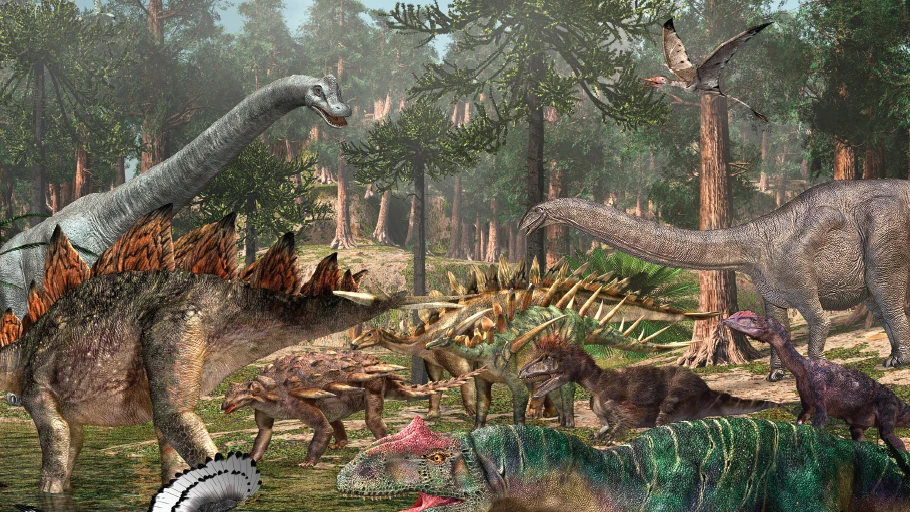
USGS reconstruction of a Jurassic dinosaur communityJurassic · about 150 Ma
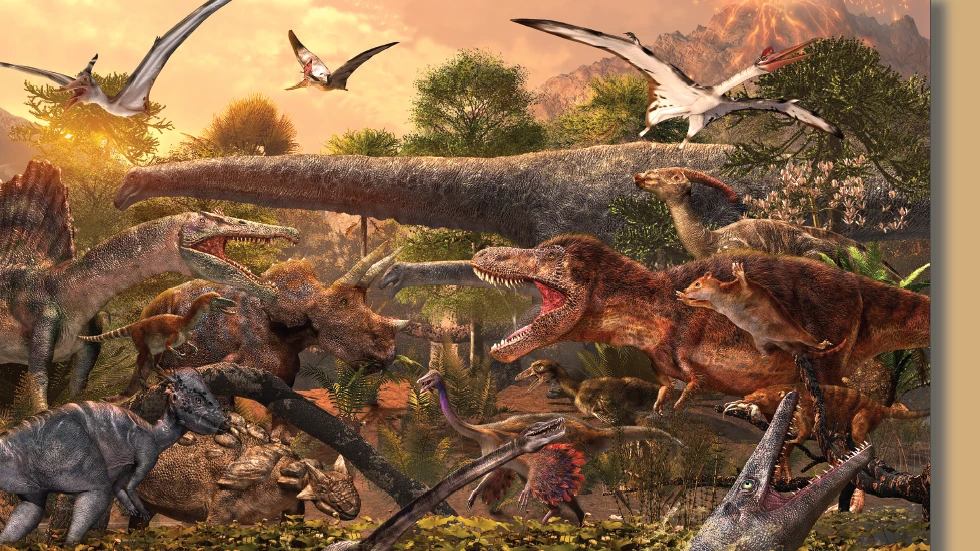
USGS reconstruction of a Cretaceous dinosaur communityCretaceous · about 75 Ma
Two windows into the age of dinosaurs

The Jurassic and Cretaceous were not one unchanging ‘dinosaur world’. These two period montages show different communities, plants and climates. The animals are based on fossils, while posture, colour and behaviour necessarily include interpretation.

U.S. Geological Survey ‘Trek Through Time’ dioramas by Masato Hattori, public domain; cropped to the illustrated scenes.These scenes are scientific reconstructions, not photographs. Each represents a particular interval or broad ecological montage rather than every place on Earth at that time.

What we know

  • Dinosaurs first appeared in the Late Triassic and diversified after the end-Triassic extinction. Birds are the dinosaur lineage that survives today.
  • Early mammaliaforms and mammals were more varied than the old image of tiny, uniform night-dwellers suggests, although most remained small beside many dinosaurs.
  • Feathers evolved before powered flight and served several roles. Colour can be estimated only in exceptionally preserved fossils, and even then the result is probabilistic.
  • The Chicxulub impact 66 million years ago was the main trigger of the K–Pg mass extinction. Deccan volcanism and other environmental changes formed part of the wider background.

Moments that changed the planet

The first dinosaurs

Small and medium-sized forms appear before dinosaurs later become dominant in many ecosystems.

Early mammal relatives diversify

Distinctive mammalian jaws, ears and teeth emerge through a long sequence of evolutionary changes.

Archaeopteryx takes flight—or nearly so

This feathered Jurassic theropod sits close to the early history of birds.

The K–Pg extinction

Non-avian dinosaurs disappear, while birds, mammals and many other lineages survive.

What scientists are still working out

Fossils rarely preserve behaviour, sound, skin pattern or soft tissues. Good reconstructions separate what the bones and impressions show from what has to be inferred.

Chapter 6

Cenozoic

66.0 Ma–present

Mammals and birds expanded into newly opened roles, the climate cooled overall, grasslands spread, whales returned to the sea, and one branch of African apes eventually gave rise to Homo sapiens.

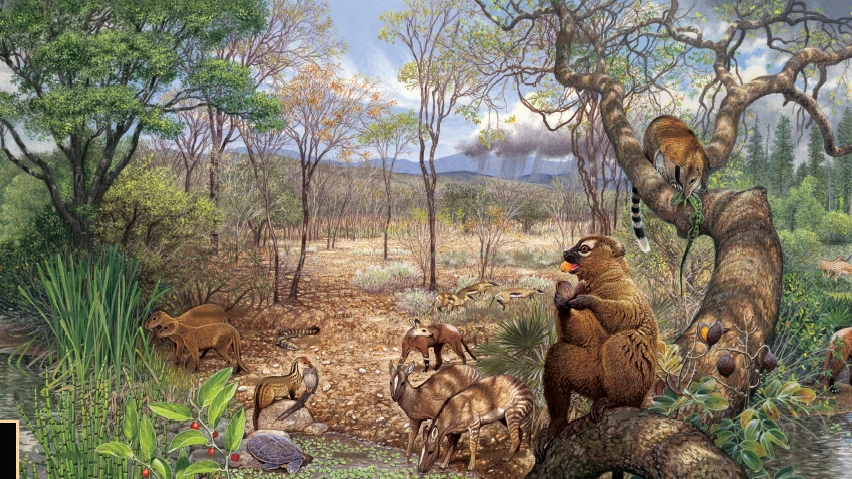
USGS reconstruction of a Paleocene forest and mammal communityPaleocene · 66–56 Ma
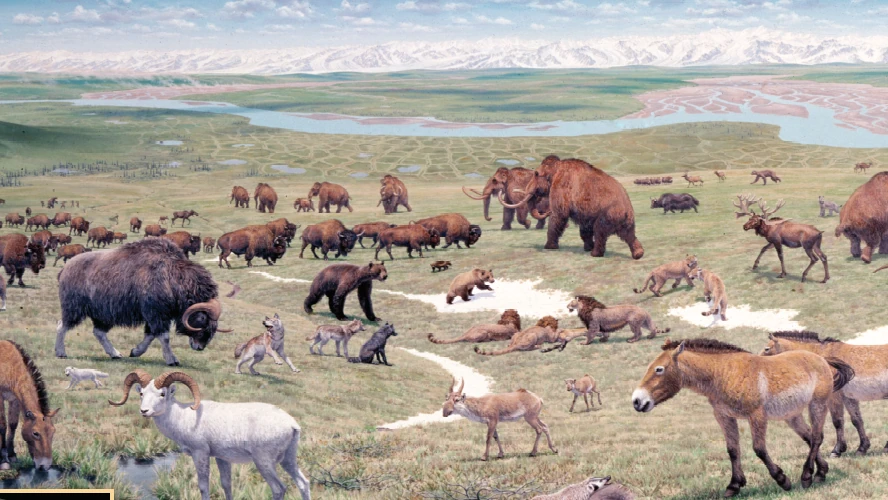
USGS reconstruction of a Pleistocene grassland with Ice Age mammalsPleistocene · last 2.6 Myr
After the asteroid: two very different worlds

The left scene imagines an early Paleocene ecosystem soon after the K–Pg extinction; the right depicts a Pleistocene grassland with Ice Age mammals. Together they show how much the Cenozoic changed, rather than presenting one timeless scene.

U.S. Geological Survey ‘Trek Through Time’, public domain. Paleocene diorama by Aldo Chiappe; Pleistocene diorama by J. Matternes, courtesy of the Smithsonian; cropped to the illustrated scenes.These scenes are scientific reconstructions, not photographs. Each represents a particular interval or broad ecological montage rather than every place on Earth at that time.

What we know

  • Mammals were already diverse before the K–Pg extinction, but many major modern groups expanded rapidly after it.
  • Whales evolved from land-dwelling relatives of even-toed ungulates during the Eocene. A series of fossils records the transition; no single fossil represents the one direct ancestor of every whale.
  • Human evolution is a branching story in which several species overlapped and sometimes exchanged genes. It is not a ladder from “primitive” to “advanced”.
  • Homo sapiens evolved in Africa about 300,000 years ago. Our entire history occupies only a tiny sliver of the planet’s past.

Moments that changed the planet

Life expands after the extinction

Surviving mammals, birds, reptiles, fishes and plants diversify as ecosystems are rebuilt.

Whales return to the water

Eocene fossils trace a gradual shift from walking on land to living fully at sea.

The earliest possible hominins

Genetic estimates place the split between the human and chimpanzee lineages broadly in this interval, while the position of the oldest candidate fossils remains debated.

Homo sapiens appears

Fossils and genetics point to an African origin. Current evidence favours a connected network of African populations rather than one precisely located birthplace.

What scientists are still working out

The names and relationships of fossil hominins continue to change as new fossils and ancient genomes are discovered.

Deep time at a glance

Putting 4.57 billion years into perspective

These three views show the scale of Earth history, the long rise of oxygen and the timing of the five major mass extinctions. Where the rock record cannot support a single precise number, the wording remains deliberately cautious.

Earth history shown in its true proportions

Almost nine-tenths of Earth history passed before the Phanerozoic began. The width of each band follows the current international geological timescale.

Hadean536 Myr · 11.74%
Archean1531 Myr · 33.52%
Proterozoic1961.2 Myr · 42.95%
Paleozoic286.898 Myr · 6.28%
Mesozoic185.902 Myr · 4.07%
Cenozoic66 Myr · 1.45%

Myr means a duration of one million years. Some boundary ages carry a stated uncertainty, and several are formally tied to a particular layer of rock rather than to an eternally fixed number.

Oxygen rose in stages, not in a straight line

The atmosphere and oceans changed at different speeds. Local pockets of oxygen may have existed long before oxygen became common in the air.

The colour transition shows the broad direction of change. It is not a continuous measurement of global oxygen through time.

The five major mass extinctions

The markers show when each crisis occurred. Scientists do not agree on one exact global percentage of species lost, because the answer changes with the fossils, groups and methods being studied.

The Late Devonian crisis unfolded through several pulses rather than one sudden event.

About this page

A few things worth knowing

Our picture of deep time changes whenever rocks are redated, fossils are reinterpreted or new methods reveal details that were previously invisible. This page offers a careful introduction, while the sources below provide the fuller scientific record.

How this page was prepared

AI was used to help organise and translate the material, followed by a review against the sources listed below. Errors or omissions may still remain. For teaching, research or publication, check the original source before relying on a specific claim.

How to read the pictures

The ancient Earth was never photographed. The historical scenes on this page are scientific reconstructions built from fossils, rocks, geochemistry, climate models and comparisons with living organisms. Their captions state the time represented and where interpretation begins.

What is included

The journey focuses on major turning points. It cannot include every fossil site, lineage, extinction pulse or scientific disagreement.

A quick guide to the dates

Ma means “million years ago”. Geological ages are revised as measurements improve, and some boundaries are defined by a particular layer of rock as well as by a numerical age.

Privacy

This page does not ask for or store names, locations or other personal information.

Sources and updatesDates, captions and image attributions were checked against the sources below. The page should be revised when the geological timescale or the scientific picture changes.
Last reviewed 21 July 2026
Now viewing4567 Ma — present